

Quick Answer: Donkey Butter is a potent indica-dominant hybrid (70/30) bred from Grease Monkey × Triple OG with THC levels of 18–28%. It delivers deep body relaxation, sedating couch-lock, and pungent diesel-skunk aromas. Best for evening use and medical consumers seeking stress, pain, or insomnia relief.
What is Donkey Butter Cannabis?
Donkey Butter is one of those strains that earns its reputation immediately. The name is odd — no question about that — but one session with this indica-dominant hybrid and you stop caring about the name entirely. Created by Exotic Genetix, one of the most respected craft breeders in the modern cannabis space, Donkey Butter is a cross of two powerhouse parents: Grease Monkey and Triple OG. Both are known for heavy sedation, resinous buds, and diesel-forward terpene profiles — and their offspring inherits every one of those traits.
The strain sits at a 70% indica / 30% sativa genetic split. That ratio tells you a great deal about what to expect. The indica side dominates the experience, grounding the high firmly in the body. The sativa 30% shows up early — a brief mood lift and cerebral warmth — before the indica weight gradually takes over. For experienced consumers and medical marijuana patients, this is a feature, not a bug.
Donkey Butter cannabis consistently appears in conversations about the best nighttime strains, heavy hitters for chronic pain, and resin-soaked cultivars worth growing. According to Leafly’s community data (143+ verified user reports as of March 2026), the three most commonly reported effects are relaxed, sleepy, and happy — a profile that aligns tightly with the strain’s indica-dominant genetics and terpene makeup. Let’s break down exactly why this strain continues to pull attention from both recreational and medical cannabis communities.
Donkey Butter Strain Genetics and Lineage
Understanding where a strain comes from tells you a great deal about where it’s going — and in Donkey Butter’s case, the lineage is seriously impressive.
Who Bred Donkey Butter?
Exotic Genetix, based in Washington State, is the breeder behind Donkey Butter. They are the same team responsible for Grease Monkey, Kushmints, Tina, and a long catalog of modern hybrid standouts. Exotic Genetix is widely recognized in the cannabis industry for rigorous phenotype selection and precision breeding, consistently producing cultivars that combine high resin output with layered terpene complexity.
Parent 1 — Grease Monkey (GG4 × Cookies & Cream)
Grease Monkey is itself an Exotic Genetix creation — a cross of Gorilla Glue #4 (GG4) and Cookies & Cream. GG4 is famous for producing some of the stickiest, most resin-saturated buds in modern cannabis history, while Cookies & Cream contributes a dessert-leaning sweetness and vanilla notes that soften GG4’s raw diesel edge. The resulting Grease Monkey is an indica-dominant hybrid with a sweet, earthy-diesel profile and powerful sedating effects — a natural starting point for something as heavy as Donkey Butter.
Parent 2 — Triple OG (OG Kush Lineage)
Triple OG brings three OG-lineage parents into the genetic picture, cementing the pungent, earthy, fuel-forward character that runs throughout the entire Donkey Butter experience. OG genetics are well-documented for their terpene density, reliable potency, and full-body effects that experienced cannabis consumers have sought for decades.
When Exotic Genetix combined Grease Monkey with Triple OG, the result was a cultivar carrying both the GG4-derived resin production and the OG-derived terpene depth. That combination is why Donkey Butter has such extraordinary surface frost — and why it sticks to everything, including your grinder, the moment you break it apart.
Donkey Butter Cannabis Strain Profile at a Glance
| Attribute | Details |
| Strain Type | Indica-Dominant Hybrid (70% Indica / 30% Sativa) |
| Genetics | Grease Monkey × Triple OG |
| Breeder | Exotic Genetix (Washington State) |
| THC Range | 18% – 28% (some phenotypes up to 36%) |
| CBD | Typically <1% (not consistently reported) |
| Primary Terpenes | Caryophyllene, Limonene, Myrcene |
| Secondary Terpenes | Humulene, Pinene, Camphene |
| Effects | Relaxed, Sleepy, Euphoric, Happy, Couch-Lock |
| Flavors | Diesel, Earthy, Skunk, Pine, Spicy, Buttery |
| Medical Uses | Chronic Stress, Pain, Insomnia, Anxiety, Nausea |
| Flowering Time | 8–10 Weeks (Indoor), October (Outdoor) |
| Yield | Up to 600 g/m² with LST or SCROG training |
| Grow Difficulty | Beginner-Friendly to Moderate |
| Seed Format | Feminized Photoperiod (most common) |
Donkey Butter THC and CBD Levels — What the Data Actually Shows
How potent is Donkey Butter?
This is consistently the most searched question about the strain — and the answer requires real precision because the numbers vary widely across sources.
Across multiple licensed dispensary lab reports and community testing data aggregated by platforms including Leafly, AllBud, and Hytiva, the Donkey Butter strain THC level most commonly falls in the 18–22% range for standard commercial grows. Premium phenotypes and carefully cultivated batches — particularly those from Canadian licensed producers and select US dispensaries — have tested at 26–28% THC, with at least one verified UK medical cannabis batch reaching 36% THC.
Here is what the verified batch data shows:
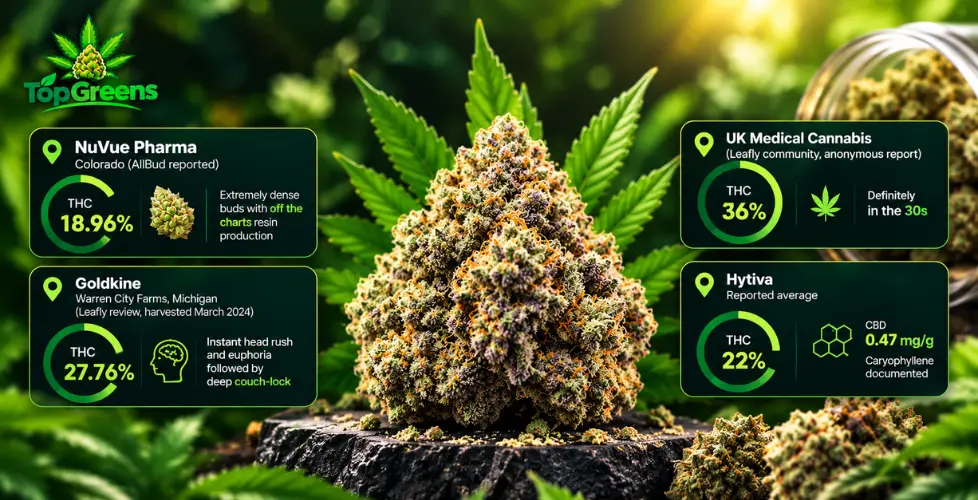
- NuVue Pharma, Colorado (AllBud reported): THC = 18.96% — described as “extremely dense buds” with “off the charts” resin production despite more modest THC numbers
- Goldkine, Warren City Farms, Michigan (Leafly review, harvested March 2024): THC = 27.76% — described as producing “instant head rush and euphoria” followed by deep couch-lock
- UK Medical Cannabis batch (Leafly community, anonymous report): THC = 36% — described as definitively “in the 30s”
- Hytiva reported average: THC = 22% with 0.47 mg/g Caryophyllene documented
What causes the wide THC range?
The variation reflects real differences in phenotype expression, cultivation environment, harvest timing, curing practices, and testing methodology — not inconsistency in the strain’s underlying genetics. A 2025 peer-reviewed study referenced by multiple dispensary sources found that concentrate labels in legal markets tend to be more accurate than flower labels due to the greater chemical consistency of extracted products. When buying Donkey Butter flower, always request the certificate of analysis (COA) for the specific batch.
CBD levels are not consistently reported across verified lab data. Most community sources and strain databases list CBD as negligible (typically <1%), placing Donkey Butter firmly in the high-THC, low-CBD category.
Donkey Butter Strain Effects and the Full High — What to Expect
The Donkey Butter strain effects follow a consistent, well-documented arc that experienced indica consumers will recognize immediately. This is not a subtle strain, and it does not behave unpredictably. It does exactly what its genetics promise — every time.
Onset: 0–10 Minutes
The first signals are cerebral. A soft warmth behind the eyes arrives, followed by a gentle mood lift and light sense of euphoria. This early phase is the sativa heritage making itself known — the Cookies & Cream grandparent lineage showing a friendly face before the OG weight sets in. Some users describe a brief window of social ease and creativity here. Enjoy it while it lasts.
Peak Phase: 15–45 Minutes
The body weight sets in progressively and unmistakably. Limbs start to feel heavier. The mind softens and slows. Thoughts become dreamier rather than focused. If you planned to do anything remotely productive this evening, that window is now closed. The effect is not uncomfortable — it is a deeply pleasant physical surrender that many experienced cannabis consumers actively seek out. The Donkey Butter high is heavy, warm, and enveloping.
Extended Phase: 45+ Minutes
Full couch-lock territory. Movement feels effortful and somewhat unnecessary. Appetite kicks in strongly — munchies are almost universally reported across community data. Eyes droop. The transition into sleep is natural and easy for most users. One AllBud reviewer put it precisely and memorably: “My body feels like it’s 1,000 lbs and movement is difficult. Eyes feel really droopy. I don’t want to do anything but sit and listen to music before passing out.”
Effect Summary
| Effect | Frequency Reported |
| Relaxed | Most Common |
| Sleepy | Very Common |
| Happy / Euphoric | Common (early onset) |
| Hungry | Common |
| Couch-Lock | Common at moderate-high doses |
Common Side Effects
- Dry mouth (cottonmouth) — most common; keep water nearby
- Dry eyes — common; eye drops recommended for extended sessions
- Dizziness or anxiety — possible at high doses, especially for novice consumers; start low
Donkey Butter Terpene Profile — The Science Behind the Smell and Effects
Terpenes are the aromatic compounds that define a strain’s character. In Donkey Butter cannabis, three primary terpenes work in concert to create the signature diesel-earth-spice profile. Understanding this terpene matrix also explains much of the strain’s medical potential — and why experienced consumers keep coming back.
According to GC-MS terpene analysis data, caryophyllene in Donkey Butter typically ranges from 0.4–0.9% by dry weight in terpene-rich batches, with myrcene and humulene measuring 0.3–0.8% and 0.2–0.4% respectively, and limonene appearing at 0.2–0.5%. Total terpene content in carefully grown batches generally measures 1.5–3.5% — on the higher end for cannabis flower.
1. Caryophyllene — Primary Terpene (0.4–0.9% DW)
Caryophyllene is Donkey Butter’s dominant terpene and the main driver of its sharp, peppery, diesel-edge aroma. What makes caryophyllene uniquely important — beyond flavor — is that it is the only terpene known to directly bind to CB2 receptors in the endocannabinoid system. CB2 receptors are primarily found in immune system tissue and are strongly associated with inflammation regulation. Preclinical research, including a study published in BMC Psychiatry and reviewed cannabis research aggregated by Sativa University (March 2026), supports caryophyllene’s potential anti-inflammatory and pain-relief properties through this CB2 interaction. This is why Donkey Butter is consistently reported as helpful for pain conditions beyond the sedative high alone.
2. Limonene — Secondary Terpene (0.2–0.5% DW)
Limonene contributes subtle citrus brightness to the Donkey Butter profile. You might not detect it as a distinct flavor note, but it prevents the heavy diesel and earth from feeling one-dimensional and contributes a slight mood-elevating quality to the early onset phase. Limonene is also associated with stress relief and anti-anxiety properties, which may partly explain the brief euphoric lift in the opening minutes before the indica body weight takes over.
3. Myrcene — Supporting Terpene (0.3–0.8% DW)
Myrcene rounds out the terpene trio with herbal, musky, earthy notes — the “dank” base you smell on the exhale and in the aftertaste. This is the terpene most associated with sedation in cannabis. A 2024 study published in Pharmaceuticals found that myrcene shortened the time it took insomniac mice to fall asleep and extended how long they stayed under. A 2022 human pilot study confirmed that even 15 mg of pure myrcene impaired simulated driving — confirming sedative effects beyond animal models. Beyond sedation, myrcene also enhances THC’s ability to cross the blood-brain barrier, amplifying the perceived potency of the high relative to what the THC percentage alone would suggest.
4. Supporting Terpenes
- Humulene — Adds herbal depth and structure; associated with potential anti-inflammatory properties
- Pinene — Contributes crisp pine brightness; may offset some memory impairment associated with high-THC strains
- Camphene — Earthy, resinous depth in some phenotypes; contributes to the “damp wood” element some users detect
Together, these terpenes create what cannabis researchers call the “entourage effect” — a synergistic interaction between cannabinoids and terpenes documented in published cannabis literature, including peer-reviewed research from the Journal of Cannabis Research and the National Institutes of Health (NIH). The entourage effect produces a fuller, more complex therapeutic experience than isolated THC alone.
Is Donkey Butter Good for Anxiety or Pain? Medical Marijuana Uses
Based on aggregated community experience reports across Leafly, Sativa University (March 2026), AllBud, and AskGrowers, the Donkey Butter weed strain is most commonly used for the following conditions:
Chronic Stress and Anxiety
The combination of deep body relaxation and the early euphoric phase makes Donkey Butter particularly effective at quieting an overactive stress response. The physical weight of the high creates a counterbalance to racing thoughts. Community data from Sativa University specifically lists anxiety and generalized anxiety disorder as the most commonly reported condition addressed by this strain.
Chronic Pain and Inflammation
Caryophyllene’s CB2-binding properties combined with myrcene’s sedative effects and high THC content create a multi-pathway approach to pain management. A 2019 study in the European Journal of Pharmacology confirmed beta-caryophyllene’s role in reducing inflammatory pain through CB2 activation — directly relevant to the terpene profile found in Donkey Butter. Users managing chronic pain from arthritis, fibromyalgia, and injury-related discomfort regularly cite this strain as effective.
Insomnia and Sleep Disruption
Perhaps Donkey Butter’s most unambiguous medical application. A 2023 randomized, double-blind, placebo-controlled crossover trial found that a THC and CBD oral oil improved sleep in adults with chronic insomnia — after two weeks, 60% of participants no longer met insomnia criteria, with no serious adverse effects (Cannaspecialists.org, July 2025 compilation). The CDC reports that 35% of U.S. adults do not get enough sleep regularly, which is a large part of why interest in high-myrcene, high-THC indica strains like Donkey Butter for sleep management continues to grow.
In a large observational study tracking 24,189 cannabis sessions across 991 medicinal users, indica-dominant strains showed significantly greater perceived efficacy for insomnia than CBD-dominant strains (BMC Psychiatry, 2022). Donkey Butter’s terpene profile — heavy myrcene, supported by caryophyllene — matches the profile most consistently linked to sleep induction in both preclinical and observational research.
Migraines and Headaches
Multiple sources including AllBud and BudExpressNow report Donkey Butter as a commonly chosen strain for migraine management. THC’s vasodilatory properties combined with the strain’s overall anti-stress effect profile are the likely mechanisms.
Nausea and Appetite Loss
The appetite-stimulating properties (munchies are almost universally reported) combined with THC’s well-documented antiemetic properties make Donkey Butter a relevant option for nausea management — including for patients using cannabis to manage chemotherapy-related side effects.
⚠️ Medical Disclaimer: All medical use information above is based on community-reported experiences and published cannabis research. It is not medical advice. Always consult with a licensed healthcare professional before using cannabis for any medical condition. Individual results vary significantly based on dosage, tolerance, personal biochemistry, and method of consumption.
What Does Donkey Butter Look, Smell, and Taste Like?
Visual Appearance
Donkey Butter buds are immediately recognizable — dense, compact, and extraordinarily frosted. Growers consistently describe them as appearing “dipped in glue,” which is the Grease Monkey/GG4 heritage showing its resin-production power. The coloring is dark olive green with deep forest tones, amber-to-orange pistils weaving through the bud structure, and a thick layer of golden-white trichomes that gives the flower a glassy, almost wet-looking sheen. When broken apart with fingers, the resin transfers immediately. When ground, it notoriously gunks up the grinder — a reliable indicator of exceptional resin density.
Aroma
The smell hits before you even open the jar fully. It is heavy, pungent, and completely unapologetic — diesel and skunk lead the charge, followed by earthy pine and a slight note of “rotting wood” or musky funk that reads as intentionally dank rather than off-putting. It is not a subtle strain. The aroma builds continuously through the flowering cycle and intensifies post-cure. Home growers take note: odor management with quality carbon filtration is non-negotiable.
Flavor
The flavor is a cleaner, more refined expression of the aroma. On the inhale: spicy, peppery diesel — caryophyllene dominant. On the exhale: musky, herbal, and earthy with a faint citrus lift from limonene. Some phenotypes deliver a surprising buttery smoothness on the finish — which is part of where the name earns itself. The smoke is thick and expansive, described as a “dense-lung” experience. Users vaping Donkey Butter consistently report that a dry herb vaporizer set between 185–195°C (365–385°F) delivers the fullest flavor without harshness.
Donkey Butter Live Resin — The Concentrate Experience
For consumers seeking the full Donkey Butter terpene experience in the most concentrated and flavorful format available, Donkey Butter live resin represents the premium expression of this strain.
Live resin is a cannabis concentrate produced from fresh-frozen cannabis flower — harvested and immediately frozen rather than dried and cured. This process locks in the volatile terpenes that would otherwise evaporate during the traditional drying and curing process, producing a concentrate with a far more aromatic and strain-accurate terpene profile than any cured-plant extract can achieve.
For a strain like Donkey Butter — whose entire identity is built on a complex, diesel-forward terpene matrix — live resin is the format that most faithfully amplifies what makes this cultivar distinctive. The sharp caryophyllene pepper, the citrus lift of limonene, and the earthy musk of myrcene are all preserved at maximum intensity. The result is a product that smells and tastes more like Donkey Butter than Donkey Butter flower does.
Live Resin vs. Flower — Potency and Format Comparison
| Format | Typical THC Range | Terpene Preservation | Best For |
| Donkey Butter Flower | 18–28% | Natural (cure-dependent) | Full onset experience, medical use |
| Donkey Butter Live Resin | 65–85% | High (fresh-frozen) | Flavor-first, experienced consumers |
| Standard Concentrates (Wax/Shatter) | 70–90% | Moderate | Budget-friendly potency |
| Distillate | 90%+ | Low | Pure potency, edibles |
Potency ranges sourced from Story Cannabis Concentrates Guide (June 2026) and Options Cannabis Company (December 2025).
Live resin is 3–5× more potent than flower by percentage. If you are new to concentrates, start with a fraction of what you would normally consume in flower form. The terpene preservation in live resin also means the entourage effect is more pronounced — a lower dose can produce a more complete experience.
Donkey Butter Flowering Time, Yield, and Full Growing Guide
The Donkey Butter weed strain earns a beginner-to-intermediate cultivation difficulty rating, though its exceptional odor production and naturally bushy structure require some environmental discipline. With proper setup, it rewards growers with one of the most resin-saturated harvests available in this potency class.
Key Growing Specifications
| Spec | Detail |
| Flowering Time (Indoor) | 8–10 weeks |
| Harvest (Outdoor) | October (Northern Hemisphere) |
| Plant Height | Under 30 inches (compact/bushy) |
| Yield (Indoor, Trained) | Up to 600 g/m² |
| Grow Difficulty | Beginner to Moderate |
| Seed Format | Feminized Photoperiod (most common) |
Growth Structure
Donkey Butter grows with a naturally bushy indica structure — wide node spacing in early vegetation that compresses as flowering begins. The canopy fills out quickly and aggressively. Left untrained, it creates a dense upper canopy that blocks light from reaching lower bud sites significantly. LST (low-stress training) during weeks 3–5 of the vegetative phase dramatically improves light penetration, canopy evenness, and final yield.
Growing Tips for Maximum Quality
Odor Control is Non-Negotiable. This strain produces an extremely aggressive pungent aroma from mid-flowering onward. A quality activated carbon filter system is essential for any indoor setup. Even outdoor growers should be aware of the odor radius during the final weeks of flowering.
Airflow and Humidity Management. Donkey Butter’s dense bud structure creates conditions favourable for mold and bud rot if humidity is not actively controlled. Maintain relative humidity (RH) below 50% during flowering and ensure strong constant air circulation. Consider a dehumidifier during the final 2–3 weeks before harvest.
Expect Exceptional Resin Output. Growers consistently report above-average trichome production, with heavy frosting beginning as early as week 6 of flowering. Buds appear almost wet under good lighting — this is the GG4 heritage doing exactly what it was bred to do.
LST or SCROG for Yield Maximization. Untrained plants leave significant yield on the table. A basic LST setup during veg translates directly into denser, larger bud sites throughout the canopy. For more experienced growers, SCROG (screen of green) training can help achieve closer to the 600 g/m² ceiling.
Vaporizer Temperature for Consumption: For home growers consuming their harvest, a dry herb vaporizer set between 185–195°C (365–385°F) delivers the most complete terpene expression without the harshness of combustion.
Donkey Butter vs. Other Hybrid Strains — How Does It Compare?
Understanding where Donkey Butter sits relative to comparable strains helps consumers and patients make better-informed decisions about which cultivar fits their specific needs.
| Strain | Genetics | THC Range | Primary Character | Best For |
| Donkey Butter | Grease Monkey × Triple OG | 18–28% | Heavy body, diesel, couch-lock | Evening, insomnia, pain |
| Gorilla Glue #4 | Chem Sister × Chocolate Diesel | 25–30% | Euphoric, instant couch-lock | Heavy users, acute stress |
| Wedding Cake | Triangle Kush × Animal Mints | 22–27% | Relaxed, euphoric, slight creativity | Evening, social anxiety |
| Gelato | Sunset Sherbet × Thin Mint GSC | 20–25% | Euphoric, balanced, dessert | Balanced day/evening |
| Donkey Breath | Varies by phenotype | 18–22% | Relaxed, calm, lighter | Mild sedation, everyday stress |
| Northern Lights | Afghani × Thai | 16–21% | Classic couch-lock, sleep | Pure insomnia, beginners |
Compared to Donkey Breath strain info, Donkey Butter is generally more potent and more sedating. Both share diesel-forward terpene character, but Donkey Butter’s GG4 lineage through Grease Monkey provides distinctly heavier resin production and a more pronounced couch-lock arc.
Against GG4 directly, Donkey Butter offers a more complex flavor profile courtesy of the Triple OG side, and a more progressive onset rather than GG4’s faster initial hit. For consumers who want the same ultimate destination — deep body sedation — but prefer a more gradual journey, Donkey Butter is the more nuanced choice.
How to Consume Donkey Butter — Dosing and Method Guide
Dosing by Experience Level
Given that Donkey Butter strain effects can be surprisingly powerful even at modest doses, approaching this strain with intention matters.
Beginners (Low Tolerance): Start with one or two small puffs and wait a full 15–20 minutes before considering more. The onset can feel deceptively mild in the first 10 minutes. The indica body weight arrives progressively — not all at once — and misjudging the arc is the most common source of overconsumption discomfort.
Intermediate Consumers: Standard session amounts apply, but be aware that batch-to-batch THC variation (18% to 28%) means what worked last time may feel different with a new batch. Always check the COA.
Experienced / Medical Consumers: This strain is designed for you. The full effect arc — from euphoric onset through progressive body stone to couch-lock and sleep — is rich and satisfying at doses appropriate to your tolerance.
Best Consumption Methods
Dry Herb Vaporizer — Recommended as the optimal method for experiencing the full Donkey Butter terpene profile. Set temperature to 185–195°C (365–385°F) for peak flavor and smooth vapor.
Flower / Joint / Pipe — Classic and effective. The smoke is thick, so a water pipe or bubbler smooths the experience significantly, particularly for those sensitive to lung expansion.
Donkey Butter Live Resin (Dab) — For experienced concentrate consumers, this delivers the most complete terpene expression and the most potent effect. Start with a very small amount. Recommended dab temperature: 315–450°F (157–232°C) for a full-spectrum, low-temperature dab.
Donkey Butter Strain: Who Is This For?
This strain is ideal for:
- Experienced cannabis consumers who actively seek heavy indica effects
- Evening and nighttime consumers who want reliable help winding down
- Medical marijuana patients managing chronic stress, pain, insomnia, anxiety, or nausea
- Growers who want a high-resin, manageable cultivar with strong yield potential
- Consumers who value terpene complexity and full-body effects over cerebral stimulation
This strain is NOT ideal for:
- New consumers with low or no THC tolerance — start far lower than you think you need
- Daytime consumers who need to stay focused, productive, or alert
- Anyone who strongly dislikes diesel, skunk, or pungent cannabis aromas
- Social settings where energy, conversation, or attention to detail is required
Where to Buy Donkey Butter in Canada
If you’re in Canada and want to experience this strain in a premium, quality-controlled format, Donkey Butter is available at Top Greens — a trusted online source for premium cannabis flower and concentrates. Top Greens carries verified, lab-tested product with accessible batch information, so you know exactly what you’re getting before you order.
Before purchasing any cannabis product, always confirm the batch COA, check the THC percentage for the specific lot, and start at a dose appropriate to your experience level. Donkey Butter rewards patience and respect for its potency — approach it that way and the experience will not disappoint.
Frequently Asked Questions About the Donkey Butter Strain
Q1. What is the Donkey Butter cannabis strain?
An indica-dominant hybrid (70/30) from Exotic Genetix, crossing Grease Monkey with Triple OG. Known for heavy body relaxation, diesel-earth aromas, 18–28% THC, and strong medical potential for stress, pain, insomnia, and anxiety. Not to be confused with Donkey Breath or Donkey Kong strains.
Q2. What are the Donkey Butter strain effects?
A two-phase arc: mild cerebral warmth and mood lift in the first 10 minutes, followed by a progressive body stone that becomes couch-lock at moderate doses. Leafly’s 143+ community reports rank relaxed, sleepy, and happy as the top effects, lasting 2–4 hours.
Q3. What is the Donkey Butter strain THC level?
Typically 18–28% across commercial batches — a Colorado batch tested 18.96%, a Michigan batch 27.76%, and UK medical batches up to 36%. Always check the COA for your specific batch.
Q4. Is Donkey Butter good for anxiety or pain?
It’s commonly reported as effective for chronic stress, anxiety, pain, migraines, and insomnia. Caryophyllene binds CB2 receptors with anti-inflammatory effects, while myrcene aids sedation and absorption. Consult a healthcare professional before medical use.
Q5. What does Donkey Butter smell and taste like?
A pungent diesel, skunk, and earthy pine aroma with a musky base. Expect peppery diesel on the inhale and a musky, buttery exhale with a faint citrus lift. The thick smoke is smoother through a water pipe or vaporizer.
Q6. How long does Donkey Butter take to flower and what are the yields?
8–10 weeks indoors, with outdoor harvests ready in October. Indoor yields reach up to 600 g/m² with LST or SCROG training. The plant stays compact (under 30 inches), but needs good airflow and humidity control below 50% during flowering.
Q7. What is Donkey Butter live resin and how does it differ from flower?
A concentrate made from fresh-frozen flower, preserving the full terpene spectrum at peak intensity. It tests 65–85% THC — 3–5× more potent than flower — and delivers the most flavor-accurate experience, recommended for experienced consumers only.
Final Thoughts — Is Donkey Butter Worth It?
Looking at the genetics, lab-verified potency, terpene science, community reports, and cultivation profile together, Donkey Butter stands out as one of the most complete indica-dominant hybrids in the premium market today. Its genetics are rock-solid, its terpene profile (caryophyllene, myrcene, limonene) works together in a scientifically meaningful way, and its effects are consistent enough to satisfy recreational users and patients alike. It’s also manageable to grow, with resin output that’s impressive for its potency class.
The honest caveats: potency varies widely between 18% and 28%, so always check your COA, the aroma isn’t for everyone, and it’s not a daytime strain.
For anyone who wants genuine couch-lock relief and a complex diesel-earth terpene experience, Donkey Butter consistently delivers — which is why it remains a staple years after Exotic Genetix released it.