

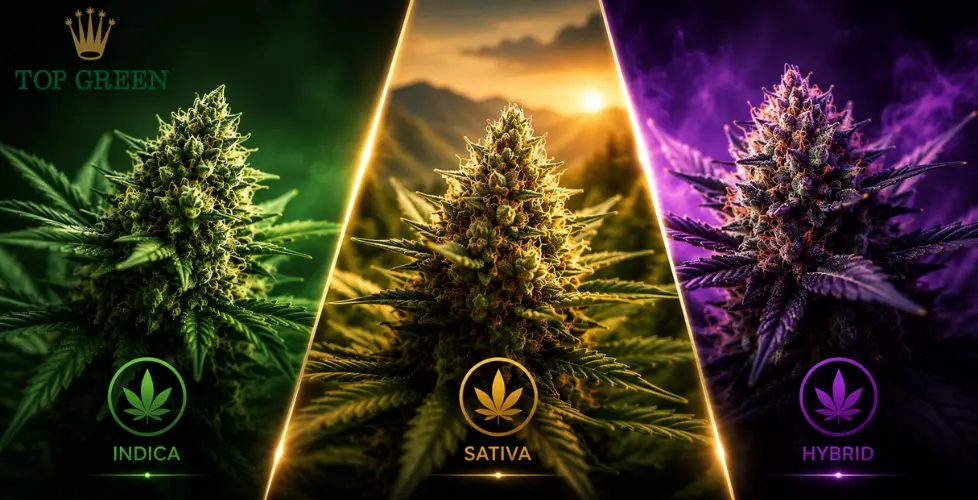
Quick Answer: Indica brings body relaxation and sedation. Sativa delivers energizing, cerebral effects. Hybrids blend both. But peer-reviewed research on 89,923+ commercial samples shows these labels often fail to match actual chemistry. Terpenes and THC:CBD ratios are far more reliable predictors of effect.
Introduction: The Label That Everyone Uses — And What It Actually Means
Every dispensary menu uses the same three words: Indica, Sativa, Hybrid. They’re the starting point for millions of cannabis shoppers every day. But are these categories actually telling you what you think they are?
The short answer is: partly. The long answer is that cannabis science has moved well beyond the traditional Indica vs Sativa vs Hybrid framework — and understanding why that matters will change how you shop forever. This guide covers everything you need to know, grounded in real peer-reviewed data.
What Is Indica Cannabis?
Indica (Cannabis indica) traces its origins to the rugged, high-altitude terrain of the Hindu Kush mountain range, spanning Afghanistan, Pakistan, India, and Turkey. Adapted to short growing seasons and cold, harsh climates, indica plants evolved compact, resin-heavy structures to survive and reproduce efficiently.
Physical Characteristics of Indica Plants:
- Short and bushy in structure — typically 3 to 6 feet tall
- Wide, broad, dark-green leaves with thick leaflets
- Dense, heavy, resin-coated buds
- Short flowering cycle of 6 to 9 weeks
- Higher natural resin production than sativa
What Effects Are Indica Strains Known For?
The classic indica experience is often described as a “body high” — a warm, heavy physical sensation that spreads through the muscles and nervous system. Users typically report:
- Deep physical relaxation and tension release
- A sedating, couch-lock quality at higher doses
- Reduced nausea and increased appetite
- Sleep support and night-time use suitability
- General stress and pain relief
Because of these associations, indica-labeled products are marketed primarily as nighttime strains — the logical reach-for when unwinding after work, managing chronic pain, or trying to get a solid night of sleep.
Key Terpenes Frequently Found in Indica-Labeled Strains:
Terpene | Scent Profile | Associated Effect |
|---|---|---|
| Myrcene | Earthy, musky, herbal | Sedation, relaxation, sleep |
| Linalool | Floral, lavender | Anxiety relief, sleep support |
| Beta-Caryophyllene | Peppery, spicy, woody | Anti-inflammatory, calming |
One key insight that most guides miss: indica’s sedating reputation is largely tied to high myrcene content, not to the “indica” classification on its own. This matters a great deal when you look at the research below.
What Is Sativa Cannabis?
Cannabis sativa tells a very different evolutionary story. It developed in equatorial climates — across Central America, Africa, Southeast Asia, and South America — where long, sun-drenched growing seasons allowed it to grow tall and branch freely.
Physical Characteristics of Sativa Plants:
- Tall and slender — can reach 10 to 12 feet outdoors
- Long, narrow leaves with thin, finger-like leaflets
- Airy, less-dense bud structure
- Long flowering cycle of 10 to 16 weeks
- Lower natural resin density than indica
What Effects Are Sativa Strains Known For?
Sativa is the “daytime strain” in cannabis culture. Its reputation is built around an uplifting, cerebral, and creativity-friendly experience. Users commonly report:
- Increased energy, motivation, and alertness
- Mental clarity and heightened focus
- Euphoria and mood elevation
- Social ease and creative stimulation
- Reduced feelings of fatigue
Because of these effects, sativa-dominant products are positioned as the morning or afternoon option — the cannabis equivalent of coffee for many users.
Key Terpenes Frequently Found in Sativa-Labeled Strains:
| Terpene | Scent Profile | Associated Effect |
|---|---|---|
Limonene | Citrus, lemon, orange | Mood elevation, stress relief |
Alpha-Pinene | Pine, fresh forest | Alertness, focus, memory |
Terpinolene | Floral, herbal, fresh | Uplifting, energizing |
One important caveat: sativa strains tend to carry higher THC concentrations with lower CBD. For users with anxiety disorders or low THC tolerance, high-THC sativa strains can amplify anxiety rather than reduce it — the opposite of what was intended.
What Is a Hybrid Cannabis Strain?
Hybrid strains are deliberate crossbreeds of indica and sativa genetics, cultivated by breeders to capture specific traits from each parent plant. Hybridization has become so normalized in modern cannabis cultivation that it is now the rule, not the exception.
The Three Types of Hybrid Strains:
- Indica-Dominant Hybrids — body relaxation is the primary effect, with mild cerebral stimulation
- Sativa-Dominant Hybrids — energy and creativity lead, with some physical balance
- Balanced (50/50) Hybrids — aim for an equal blend of both parent effect profiles
Why Were Hybrids Developed?
Cannabis breeders created hybrids for practical and commercial reasons:
- To shorten the long flowering cycle of pure sativas
- To increase potency, yield, or resin production
- To engineer specific therapeutic effect combinations
- To create unique flavor, aroma, and terpene profiles
- To adapt plants to different growing environments
The Modern Hybrid Reality:
Here is the part most guides skip entirely. While buyers still frame their choices as “picking between indica, sativa, and hybrid,” the market reality is that almost everything on shelves today is already a hybrid. This has been building across decades of continuous crossbreeding, and the data confirms it clearly.
What Does the Research Actually Say? The Science Behind the Labels
This is where the indica versus sativa versus hybrid conversation gets genuinely interesting — and where this guide diverges from most of what you’ll find online.
The three-category framework is a useful shorthand, but peer-reviewed research paints a far more complicated picture of what these labels actually tell you.
The Market Is Dominated by Hybrids — Not Pure Strains
In a catalogued dataset of 56,000+ cannabis strains analyzed by PhenoDb, 85.7% fell into hybrid-dominant categories when hybrid labels were combined. Pure indica and pure sativa strains together accounted for less than 14% of the total (PhenoDb, 2023).
The practical implication: when you pick up a product labeled simply “Indica” or “Sativa” at a dispensary, there is an overwhelming statistical probability that it already contains significant genetics from the other category.
Labels and Chemistry Rarely Align
A landmark study published in PLOS ONE analyzed 89,923 commercial cannabis samples sourced from U.S. producers. The findings challenge the entire traditional framework (Hazekamp et al., PLOS ONE, 2023):
- 96.5% of all samples were THC-dominant
- Only 1.4% were CBD-dominant
- Only 2.2% were balanced THC:CBD
- Commercial labels — Indica, Hybrid, Sativa — showed poor alignment with actual phytochemical patterns
- Samples across all three label categories were heavily intermixed chemically, rather than forming clean, predictable groups
In plain terms: a product sold as “Sativa” may have a chemical profile nearly identical to one sold as “Indica.” The label is not a reliable chemical fingerprint.
The Historical Distinction Has Been Erased
A taxonomy review published in PMC/NCBI confirmed that historical indica and sativa domesticated types were once distinguishable by THC/CBD ratios and terpenoid traits. However, decades of hybridization have largely erased those differences in today’s commercial market. The same review noted that the known strain-name database had already reached 14,348 named strains at the time of writing — a number that has continued to grow (McPartland & Guy, PMC/NCBI, 2020).
The Terpene Picture from Commercial Data
The same PLOS ONE dataset found that:
- Average total terpene content in commercial cannabis was approximately 2% by weight
- Most individual terpenes were below 0.2% in most samples
- The three most common terpenes across all samples — regardless of label category — were myrcene, beta-caryophyllene, and limonene
Modern cannabis is dominated by hybrids, not by pure indica or pure sativa lines. Commercial strain labels often fail to predict chemical composition with precision. Terpene profiles and cannabinoid ratios provide a more meaningful framework than traditional strain stereotypes.
What the Numbers Actually Show
The following data is suitable for visual reference panels or infographic production:
| Panel | Key Stat |
|---|---|
| 🌿 Market Reality | 85.7% of 56,000+ catalogued strains are hybrid-dominant |
| 🧪 Commercial Chemistry | 96.5% of 89,923 U.S. samples were THC-dominant |
| 🍋 Top 3 Terpenes | Myrcene, Beta-Caryophyllene, Limonene (found across all label categories) |
| 🔀 Label Mismatch | Indica/Sativa/Hybrid labels show poor phytochemical alignment; samples are heavily intermixed |
| ⚠️ Legal Twist | 84.5% of CBD-dominant samples still exceeded 0.3% THC — above U.S. hemp threshold |
Why Terpenes Matter More Than the Strain Label
If labels don’t reliably predict effects, what does? The scientific consensus increasingly points to terpenes — the aromatic compounds responsible for the distinct scents and flavors of cannabis (and many other plants).
Terpenes interact with cannabinoids like THC and CBD through what researchers call the “entourage effect” — a synergistic relationship in which the combined action of multiple compounds produces effects that neither would produce alone. This means the full chemical profile of a product, not its category label, is what shapes your experience.
Here are the five terpenes that matter most when reading any cannabis product:
Myrcene
Scent: Earthy, musky, herbal, mango-adjacent
Effect: Sedating, relaxing, sleep-supportive
Commonly found in: Indica-labeled strains, mangoes, hops, lemongrass
Best for: Evening use, chronic pain, insomnia, muscle tension
Myrcene is the single most abundant terpene across all commercial cannabis samples. It is also the compound most responsible for the “couch-lock” sedative effect historically attributed to indica — meaning a high-myrcene hybrid may be more sedating than a low-myrcene indica.
Limonene
Scent: Citrus, lemon, orange, fresh
Effect: Mood elevation, stress relief, uplifting energy
Commonly found in: Sativa-labeled strains, citrus fruits, juniper
Best for: Daytime use, mood support, mild anxiety relief, focus
Limonene is largely responsible for the feel-good, energizing reputation of sativa strains. If mood elevation is your goal, a high-limonene terpene panel is a stronger buying signal than a “Sativa” label alone.
Beta-Caryophyllene
Scent: Peppery, spicy, woody
Effect: Anti-inflammatory, calming, analgesic
Commonly found in: Most cannabis strains, black pepper, cloves, rosemary
Best for: Pain relief, inflammation, low-level anxiety
Beta-caryophyllene is unique: it is the only terpene known to bind directly to CB2 endocannabinoid receptors, giving it cannabinoid-like properties. It is one of the most consistently present terpenes across all label categories — which is why it shows up as a top-three terpene in the PLOS ONE dataset.
Alpha-Pinene
Scent: Pine, fresh forest, crisp outdoor air
Effect: Alertness, improved memory retention, counteracts some THC-related cognitive cloudiness
Commonly found in: Some sativa strains, pine needles, rosemary, dill
Best for: Daytime use, focus, managing THC-induced memory fog
Linalool
Scent: Floral, lavender, light and soft
Effect: Anxiety reduction, relaxation, mild sedation
Commonly found in: Indica-leaning strains, lavender, birch trees
Best for: Anxiety, stress management, sleep difficulties
Indica vs Sativa vs Hybrid:
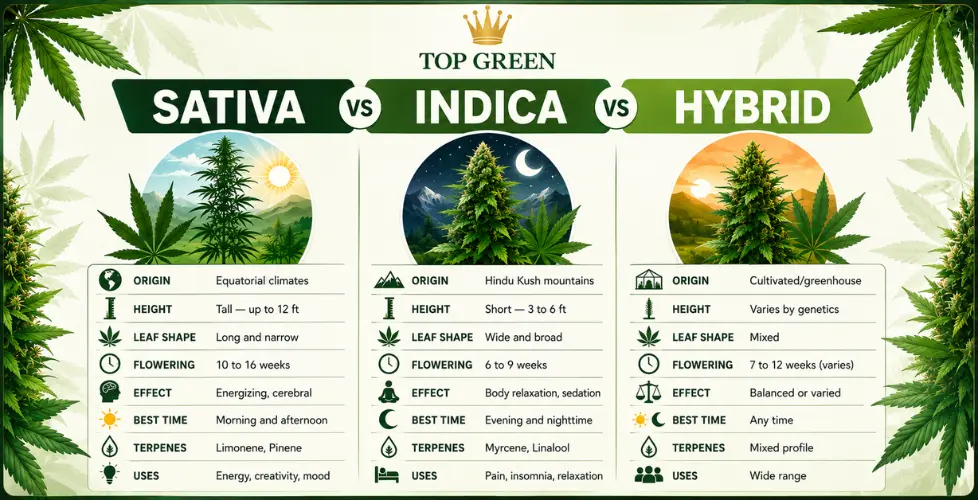
| Feature | Indica | Sativa | Hybrid |
|---|---|---|---|
| Geographic Origin | Hindu Kush mountains | Equatorial climates | Cultivated/greenhouse |
| Plant Height | Short — 3 to 6 ft | Tall — up to 12 ft | Varies by genetics |
| Leaf Shape | Wide and broad | Long and narrow | Mixed |
| Flowering Time | 6 to 9 weeks | 10 to 16 weeks | 7 to 12 weeks (varies) |
| Traditional Effect | Body relaxation, sedation | Energizing, cerebral | Balanced or varied |
| Ideal Time of Day | Evening and nighttime | Morning and afternoon | Any time |
| Typical THC Level | Variable (often lower) | Often high | Highly variable |
| Typical CBD Level | Often slightly higher | Usually low | Highly variable |
| Primary Terpenes | Myrcene, Linalool | Limonene, Pinene | Mixed profile |
| Common Uses | Pain, insomnia, relaxation | Energy, creativity, mood | Wide range |
| Label Reliability | Low (per PLOS ONE data) | Low (per PLOS ONE data) | Low (per PLOS ONE data) |
What Is the Difference Between Indica, Sativa, and Hybrid?
For anyone asking via voice search or AI assistant, here is the clearest possible answer:
The difference between indica, sativa, and hybrid comes down to three things: plant genetics, traditional effect profiles, and actual chemical composition.
- Indica = compact mountain plant, body-relaxing effects, high myrcene terpene tendency, suited for evening use
- Sativa = tall equatorial plant, energizing cerebral effects, limonene/pinene tendency, suited for daytime
- Hybrid = crossbred genetics; effects depend on dominant parent genetics and terpene profile
- The difference between sativa and indica and hybrid in today’s market is often more about branding and marketing position than true botanical distinction
The most critical practical takeaway: look at the terpene profile and cannabinoid ratio before the label.
Indica vs Hybrid: Which Should You Choose?
The choice between indica vs hybrid comes down to what you need and how sensitive you are to THC.
Choose an Indica-Labeled Strain If:
- Deep, body-focused physical relaxation is the primary goal
- You are using cannabis specifically for sleep support or nighttime pain management
- You want maximum sedation and are using in the evening only
- You have prior experience and understand your THC tolerance
Choose an Indica-Dominant Hybrid If:
- You want the relaxing body effect but still need some mental clarity
- You are newer to cannabis and want something less fully sedating
- You need a strain that bridges late afternoon and evening
- You want manageable effects that allow you to remain somewhat functional
Indica-dominant hybrids often represent the practical sweet spot — delivering physical comfort without the complete mental shutdown of a high-myrcene pure indica. Strains like Fritter Glitter or LA Kush Cake are good examples of this balance.
Hybrid vs Sativa: Key Differences Explained
When comparing hybrid vs sativa, the central question is: how much energy and mental stimulation do you actually want?
Choose a Pure Sativa-Dominant Strain If:
- Maximum cerebral stimulation and sustained energy are the goal
- You have a high THC tolerance built over time
- You are using in the morning before a demanding creative or social session
- You do not have a significant predisposition toward anxiety
Choose a Sativa-Dominant Hybrid If:
- You want uplifting energy with slightly more physical balance
- You are concerned about anxiety from pure, very high-THC sativa strains
- You want a versatile daytime strain with a smoother edge
- You are newer to cannabis and want something approachable
In practice, most of what dispensaries label as “Sativa” is already a sativa-dominant hybrid. True landrace sativa genetics are difficult to source in the modern commercial market.
Explore Premium Indica, Sativa & Hybrid Strains
Ready to shop smarter? At Top Greens, every strain in our bud collection includes detailed type information, flavour profiles, and medical applications — so you can make an informed choice rather than guessing from a label alone.
| Strain | Type | Flavour Notes | Common Uses |
|---|---|---|---|
| Donkey Butter | Indica | Butter, pungent, diesel | Pain, stress, anxiety |
| MK Ultra | Indica | Strong, earthy | Pain, stress, insomnia |
| LA Kush Cake | Hybrid Indica-Dominant | Vanilla, mint, pepper | Anxiety, stress, depression |
| White Truffle | Hybrid Indica-Dominant | Butter, nutty, skunk | Anxiety, stress, depression |
| Fritter Glitter | Hybrid Indica-Dominant | Citrus, lavender, earthy | Stress, PTSD, depression |
| Georgia Pie | Balanced Hybrid | Fruity, peach, apricot | Anxiety, stress, pain |
| Frosted Gelato | Hybrid Sativa-Dominant | Blue cheese, butter, sweet | Anxiety, stress, depression |
| Tropical Runtz | Hybrid Sativa-Dominant | Citrus, fruity, tropical | Anxiety, stress, depression |
Whether you’re looking for indica-dominant comfort, sativa-dominant energy, or a versatile balanced hybrid, explore our full range at topgreens.io.
How to Choose the Right Cannabis: A 4-Step Practical Framework
Instead of asking “is this an indica, sativa, or hybrid?” — use this smarter buying approach:
Step 1: Define Your Actual Goal
What outcome are you looking for? Be specific:
- Sleep and relaxation
- Chronic pain or inflammation management
- Mood support or generalized anxiety relief
- Energy, creativity, or focus enhancement
- Social ease or euphoria
- Nausea relief or appetite stimulation
Step 2: Check the THC:CBD Ratio
- High THC, low CBD → Stronger psychoactive effects; may intensify anxiety in sensitive users
- Balanced THC:CBD → More mellow, often well-tolerated by beginners, better for anxiety
- High CBD, low THC → Minimal psychoactive effect; body-focused benefits dominate
Step 3: Read the Terpene Profile
Look for the top 2 to 3 terpenes listed on the product label or certificate of analysis (COA). Use the terpene guide above to match the profile to your intended experience.
Step 4: Consider Your Consumption Method
The same strain can feel quite different depending on how it enters your system:
| Method | Onset | Duration | Notes |
|---|---|---|---|
| Smoking / Vaping | Minutes | 2 to 3 hours | Fast, predictable, lung-related risks |
| Edibles | 30 to 90 min | 4 to 8 hours | More potent, harder to dose; 11-hydroxy-THC conversion |
| Tinctures | 15 to 45 min | 3 to 6 hours | Predictable dosing, easy to adjust |
| Capsules / Pills | 30 to 90 min | 4 to 8 hours | Consistent dosing, similar to edibles |
Who Should Use Indica, Sativa, or Hybrid?
| User Profile | Recommended Starting Point |
|---|---|
| First-time cannabis user | Low-THC balanced hybrid or CBD-dominant strain |
| Chronic pain or inflammation | Indica or indica-dominant hybrid (high myrcene + caryophyllene) |
| Daytime creative work | Sativa-dominant hybrid (limonene-forward profile) |
| Managing anxiety | CBD-rich balanced strain; avoid high-THC sativa |
| Sleep difficulties / insomnia | Indica or indica-dominant (myrcene + linalool) |
| Social or recreational evening | Balanced or lightly indica-dominant hybrid |
| Experienced user, high THC tolerance | Any type based on personal terpene preference |
| Medical users | Requires full COA review and healthcare professional guidance |
Does the Indica/Sativa/Hybrid Distinction Matter for Medical vs Recreational Use?
This question comes up frequently — and the answer genuinely differs based on your use case.
For recreational users, the indica/sativa/hybrid label is a reasonable directional starting point. If deep sleep and physical relaxation is the goal, an indica label increases the odds of getting there. If daytime energy is needed, a sativa label is the more likely match. The label is not chemically precise, but it is directionally useful for low-stakes choices.
For medical cannabis users, the label is a weaker tool and should not be relied upon alone. If you are managing a specific condition — chronic pain, PTSD, epilepsy, anxiety disorder — you need more precision than a three-category label provides. Request the product’s Certificate of Analysis (COA) from the producer, which displays the full cannabinoid panel and terpene breakdown. Use those numbers to match to your specific needs, ideally with guidance from a healthcare professional or trained cannabis consultant.
As the market matures and standardized testing becomes more common, terpene and cannabinoid-based classification will likely eventually replace the traditional Indica/Sativa/Hybrid label system entirely. Several producers in Canada are already moving in this direction.
Frequently Asked Questions: Indica vs Sativa vs Hybrid
Q1. What is the main difference between indica and sativa?
Indica is traditionally associated with body relaxation and sedation; sativa with energizing, cerebral effects. In today’s commercial market, however, these labels do not reliably reflect actual chemical composition.
Q2. Are hybrid strains always a 50/50 mix of indica and sativa?
No — hybrids can be indica-dominant, sativa-dominant, or balanced, depending entirely on parent genetics and the breeder’s intent. The ratio varies significantly by strain.
Q3. Does indica always make you sleepy?
Not always. The sedative quality is more closely tied to myrcene content than the label. An indica low in myrcene may not be sedating, while a hybrid with high myrcene concentration can produce strong couch-lock.
Q4. Is sativa better or worse for anxiety?
High-THC sativa strains can increase anxiety in predisposed individuals, especially at higher doses. For anxiety management, a balanced or indica-dominant hybrid with higher CBD and calming terpenes — linalool or caryophyllene — is typically the safer and more effective choice.
Q5. Do indica, sativa, and hybrid labels reliably predict the effects you’ll feel?
Research published in PLOS ONE — analyzing 89,923 commercial samples — found these labels showed poor alignment with actual phytochemical patterns. Samples from all three label categories were chemically intermixed rather than forming distinct groups.
6. What terpene causes the sleepy effect in cannabis?
Myrcene is the terpene most consistently associated with sedation and the “couch-lock” effect. It is the most prevalent terpene across all commercial cannabis samples and is the most reliable predictor of a sleep-supportive strain — regardless of what the label says.
7. How do I choose between indica, sativa, and hybrid?
Look beyond the label. Check the THC:CBD ratio for potency context and read the terpene profile for specific effect guidance. These two data points together provide far more predictive power than any category label.
Final Thoughts
The research makes one thing clear: the indica vs sativa vs hybrid framework is a useful orientation tool, but it is not a precision buying guide.
In a market where 85.7% of catalogued strains are hybrids, and where commercial labels show poor alignment with actual phytochemical chemistry, leaning too heavily on a three-word label is leaving a lot of your experience to chance. The classic indica-sativa divide is historically meaningful, but it is far less reliable in today’s hybridized marketplace.
The smarter path: move past the label. Check the cannabinoid ratios (THC vs CBD). Read the terpene profile. Match those numbers to your specific goals. That’s how experienced buyers — and the research — recommend approaching strain selection.
Key Takeaways:
- Indica = relaxing, body-focused, nighttime — driven primarily by myrcene
- Sativa = energizing, cerebral, daytime — driven primarily by limonene and pinene
- Hybrid = versatile blend; effects depend entirely on dominant genetics and terpene profile
- Labels in modern cannabis often fail to reflect actual chemistry — always check the COA
- Terpenes and cannabinoid ratios are the most reliable predictors of your experience
One thought on “Indica vs Sativa vs Hybrid: Which Is Right for You? ”